The small details …

For a long time, I believed I knew exactly what I was good at. I thought my strengths were rooted in execution, structure, and operating inside the defined lines of what success was supposed to look like. I believed that discipline alone would create outcomes — that if I worked hard enough, long enough, and stayed focused on the details, everything else would fall into place. Experience, however, has a way of forcing honesty. Over time, I came to realize that some of the things I thought I was great at, I simply wasn’t — at least not in the way I once believed. And perhaps more importantly, some of the qualities I never fully valued in myself — curiosity, imagination, the willingness to dream bigger, and the ability to see something before it exists — turned out to be far more powerful than I had given them credit for.

For years, I underestimated the value of asking bigger questions. I underestimated the importance of allowing ideas to form before the path was obvious. I underestimated the role of intuition in building something meaningful. What I once viewed as distractions — thinking too broadly, seeing too many possibilities, constantly questioning the “why” behind established norms — I now recognize as a form of professional instinct. The ability to see what others may not yet see is a superpower. But like any superpower, it comes with responsibility, and it comes with friction. When your mind moves faster than the environment around you, alignment becomes harder. Details can feel constraining. Teams can feel like they are catching up. Plans can appear unfinished because the vision continues to evolve. The same curiosity that fuels innovation can also create tension when others are looking for certainty.

Earlier in my career, I assumed the answer was to adjust myself — to dial things back, to narrow the aperture, to operate inside the comfort zone of what felt familiar to others. Over time, I realized the real adjustment wasn’t about thinking smaller. It was about finding the right company, the right platform, and the right environment that allows both imagination and execution to coexist. Big ideas without execution remain ideas, and execution without imagination limits how far you can go. The goal is not to suppress the instinct to think differently, but to pair it with structure, with great people, and with a company capable of carrying those ideas forward.

For me, United Transportation has become that platform. Not as an endpoint, but as a starting point — a proving ground for ideas that extend far beyond what may be visible today. It is the foundation that allows curiosity to become capability, and the place where questions begin to turn into strategy. When I look ahead, I don’t just see incremental progress. I see steps. Clear ones. The next three moves are visible, even if the exact path to each one is still being constructed. That is both exciting and humbling, because seeing what could be is only the beginning. Building it is the real work.

Right now, my focus is not on whether the opportunity exists — it does. The focus is on how to align people, timing, capital, and execution in a way that allows something bigger to emerge. Professional growth, at least for me, has not come from becoming someone entirely different. It has come from understanding which parts of myself were always meant to be leaned into, not away from — curiosity, vision, the willingness to question assumptions, and the drive to build something meaningful even when the path is not fully defined. Finding the right platform changes everything. Because when the environment matches the instinct, momentum becomes possible. And when momentum builds, what once felt distant starts to feel inevitable.

I don’t have every answer yet. But I can see enough to know that the direction is right. And sometimes, that is exactly where you need to be.

Can you play golf this week?

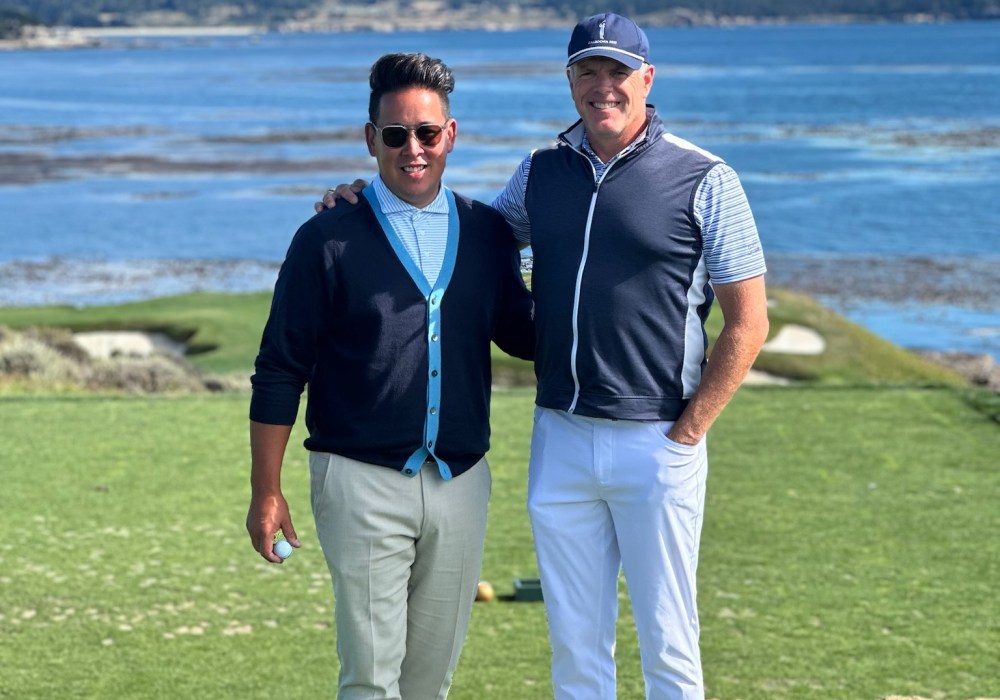
Late last year, I made a call to a good friend and asked what I thought was a very simple and easy question: “Can you go to Pebble Beach in a few days?” I knew my friend’s passion for golf, and received a “Yes” in a short period of time. It was quite nice with no big planning process or elaborate itinerary. We just made the decision to go.

Within those few days, we had the hotel booked, the plane tickets purchased, and four tee times established across SpyGlass, Spanish Bay, Pebble Beach, and The Preserve (offsite). I remember arriving on our first day and teeing off at SpyGlass in complete awe. I wasn’t sure how any other day or round could possibly be better. Well, the days certainly got better, and we had three total days of bliss. Standing on those cliffs with the Pacific stretching out forever, it’s hard not to feel a little small in the best possible way. Carmel, California has a way of reminding you that some places live up to every bit of the hype.

I felt very fortunate and appreciative that week in not only being able to play these world-class courses, but also to connect with my friend. From the drive up the coast, through the rounds of golf, and dinner/drinks after hours, we talked about life, our families, our businesses, the wins, the frustrations, and the things we’re trying to figure out next. We even had the time to make an incredible joint Spotify playlist that I listen to weekly. In the end, I recognized after getting home from this trip that these types of relationships and having real, non-surface-level conversations are important. They aren’t happening between rushed meetings, trying to get home after work, or between calendar invites.

It happens between two friends, in an amazing part of the world, with uninterrupted time for real conversations.

AND….. Somewhere during the second day, it hit both of us…..

We didn’t want the trip to end. Not because of the golf. Not because of the views.

But because it reminded us of something simple that’s easy to forget when life gets busy.

Sometimes the best moments aren’t the ones you plan for months. They’re the ones you decide to say yes to on a whim.

I leave you with this quote that I heard a little while ago. “I don’t have a favorite place. I have my favorite people. And whenever I’m with my favorite people, that place becomes my favorite.”

How to Fix Your Entire Life in ONE DAY…


How is your “New Years resolution” going? We are almost at the end of first quarter, 2026.

I am not one to post my NYR on any platform because (a) I decided a while back that I wouldn’t commit to a specific resolution and (b) I don’t think social media is always the appropriate platform/place to say what you want to accomplish, change, remove for the coming year.

All that said, I read a thought provoking article published by Dan Koe over the holiday break. This was titled “How to fix your entire life in one day.” That title alone had me curious and also pessimistic that I would gain any real value from spending the 10-15 minutes reading his blog entry.

Well – I was wrong.. This hits so many key points inside and outside of making New Year’s resolutions. His focus on deep life change, breaking unconscious patterns, and how to redirect identity toward a new trajectory with your life had me thinking of the past year and new changes for this year. There are dozens of other great ideas, including setting up your day for reflection. Something I don’t take advantage of today.

In the most simplistic terms “our resolution failures are because we didn’t commit to the new dignity and we are optimized and happy with where we are today.”’

Other summarized thoughts:

– You must become the person who naturally lives the life you want.

– Real change requires changing the goal lens through which reality is perceived.

– You are not afraid of failure — you are afraid of becoming someone your current identity cannot survive.

– Its core message:

• You don’t need more discipline
• You need a new identity lens
• You don’t lack clarity — you avoid the truth
• Change happens fast once internal resistance collapses


I hope you enjoy and give this a read.

https://letters.thedankoe.com/p/how-to-fix-your-entire-life-in-1

Stop Chasing “Set for Life”

Have you ever said to yourself, “If I can do this, get this, have this – I will be set for life?” I have. Many times, over the past 30 years.

When I took some time off in 2024, I did some reflecting on the chasing of that feeling and why I was hellbent on trying to be “set for life.” The decisions I made, the jobs that I evaluated or the dreams I wanted to fulfill.  I saw this pattern and wanted to learn from it. I worked with a coach, and after a few sessions and analyzing various examples, the lightbulb went off. It was a simple idea, almost annoyingly obvious once you hear it out loud: there’s no such thing as being “set for life.”

Most of us grow up believing this mythical moment exists—a number in the bank, a title, a business sale, a finish line we think will deliver permanent ease or certainty. We imagine that once we reach it, we’ll exhale for the rest of our lives. No stress, no questions, no doubts.

But that moment isn’t real, and more importantly, the pursuit of this carries a cost.

The key takeaways after my coaching sessions could be summarized with “When people say they want to be set for life, they’re not chasing a reality—they’re chasing a feeling.” It’s the imagined feeling of safety, love, validation, or completion. The idea that one day we can say, “I made it,” and everything after that will be easy.

Here’s the problem: because the target is a feeling, not a fact, it moves.
Every time you get close, it shifts.
Every win is discounted because it isn’t the win.
Every milestone is dismissed because it isn’t that milestone.

While we search for being “set for life,” and that big bang validation, we missed out on the real tangible validations that were sitting right in front of us. The wins we earned, the progress we made, the risks and challenges we survived, the people we helped, and the complex problems we solved. The worst of all – we overlooked the proof that we were already building something meaningful.

Now for the fun part …


Assuming you were the fortunate one to achieve that large goal – the money, title, business sale, whatever your version is—you likely felt underwhelmed and probably reset for the next big “set for life” milestone.  Because the moment you reached that mythical goal, it didn’t come with the fireworks you imagined. It didn’t fix everything. Life still has challenges and is not frictionless, and in the end, we start asking ourselves, “Was it really about the milestone?” I believe it’s about the feeling we hoped we would feel upon reaching the “set for life” milestone.

All that said, I am still focused on short-term and long-term personal and professional goals. I am still driven by the idea of building success with the company I recently acquired. I still dream about what retirement could look like in the next chapter of life. However, it’s not tied to a set dollar amount, a timeframe for an exit strategy, or a set date in the future to stop working. As my wife says from time to time, “Let the universe do its thing,” which I fully subscribe to now. I am more in touch with what is happening today, and I have a greater appreciation for what is happening around me, my family, friends, and colleagues. I am no longer waiting for some final moment to feel complete.

To summarize,  being “set for life” isn’t a finish line—it’s a mindset.

We become “set for life” by realizing we’re already living it, one earned win at a time.