When Entrepreneurial DNA Meets an Established Business
Learning to balance the speed of innovation with the patience of leadership.
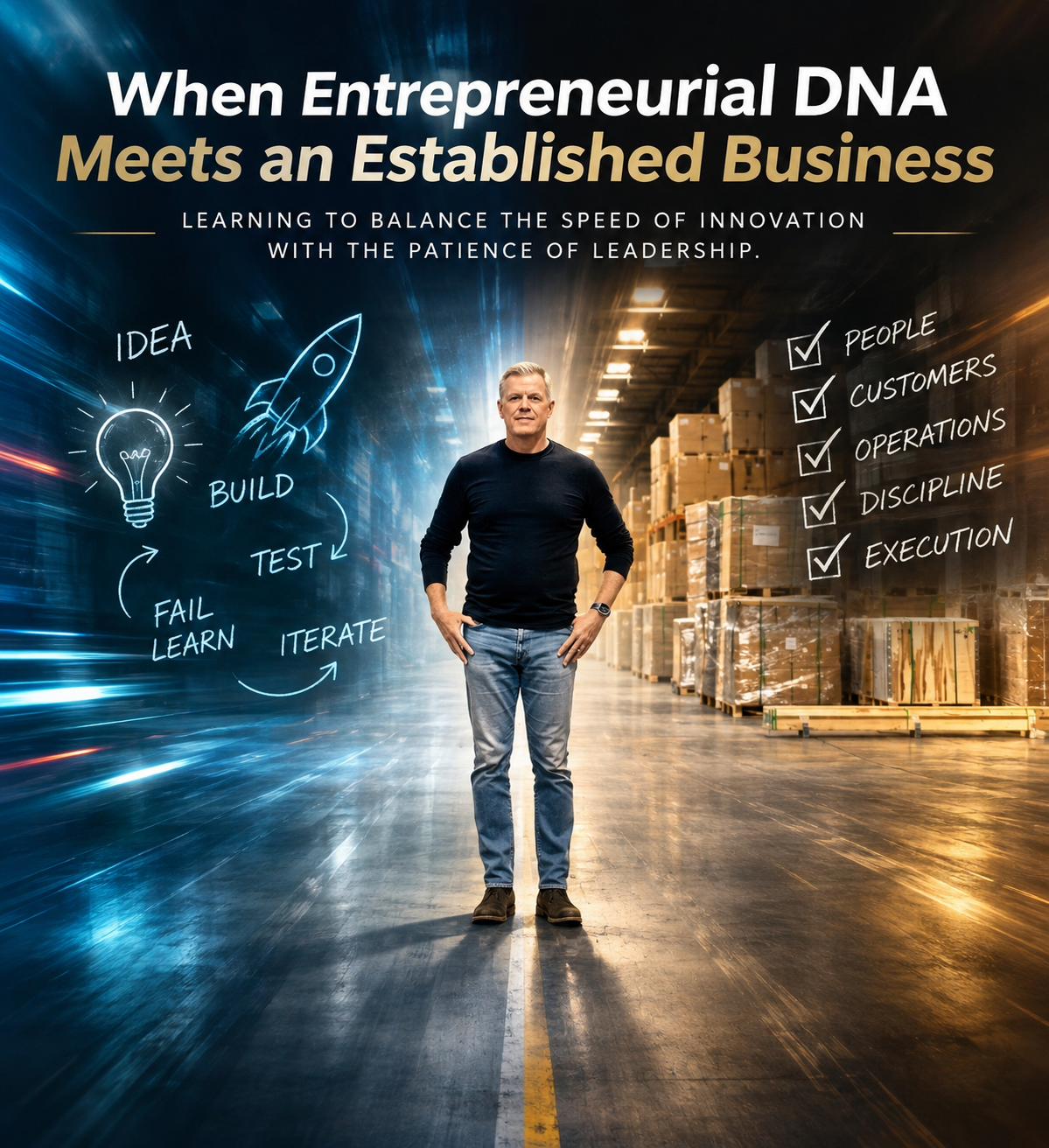
For most of my 30-year career, my professional DNA has been shaped by building things. New companies, new products, new ideas, new concepts, and occasionally things that didn't even have a market yet. I've spent much of my career in environments where speed mattered, experimentation was encouraged, and failure wasn't necessarily a bad thing. It was often just another step toward figuring out what actually worked.
I've always believed that you learn more by doing than by endlessly debating what might happen. Build it, test it, put it in front of customers, listen, adjust, and try again. Sometimes you get it right. More often, you don't. But with enough repetitions, enough failures, and enough small victories, you eventually find the secret recipe. And when you do, there's nothing quite like watching something that started as an idea become something real.
That mentality has served me well throughout my career. It's also created certain expectations about how quickly things should move, how decisions should be made, and how comfortable people should be operating in an environment where not everything is figured out. I've always been comfortable with uncertainty. I've been less comfortable standing still.
Over the past year and a half, however, I've found myself in a different environment. Rather than building something entirely from scratch, I'm leading an established business with a history, an existing culture, experienced employees, long-standing customer relationships, and operating processes developed over many years.
And while my entrepreneurial instincts haven't changed, I've come to appreciate that the environment in which I'm applying them has.
In a startup, people generally sign up knowing they're getting on a roller coaster. The direction might change three times in a week, priorities can shift overnight, and everyone understands that the business is still trying to figure out what it wants to become. There's a certain energy that comes with that uncertainty. You expect people to move quickly, challenge assumptions, and embrace the idea that what worked yesterday might not work tomorrow.
An established business is different. People have spent years building relationships, developing expertise, and creating processes that allow the company to deliver for its customers every day. They take pride in what they've accomplished, and rightfully so. An operational rhythm and level of accountability can't be disrupted every time someone has a new idea. Relationships are key in our sector. Long-standing relationships make and break deals daily. I know that can be common in other sectors; however, it's front and center in our daily operation.
Just because I can see where I want to go doesn't mean everyone else can see it at the same time.
I've spent enough years around start-ups and new product development to recognize patterns, connect dots, and picture what something could become before all the pieces are in place. It's one of the benefits of experience. You start to recognize opportunities a little earlier, anticipate obstacles a little faster, and develop conviction around ideas that may not yet be obvious to others.
But I've also learned that having conviction in a vision and communicating it effectively are two very different things.
What seems clear in my head may require considerably more explanation, context, and patience for someone who hasn't had the same experiences. And expecting people to immediately embrace a destination they haven't yet had the opportunity to understand isn't necessarily a reflection of their capabilities or willingness to change. Sometimes it reflects my own failure to bring them into the thinking early enough.
That's been a valuable lesson.
There's another important dimension to this experience. I'm also learning a new industry, with its own complexities, operating realities, customer expectations, and nuances that don't always reveal themselves from the outside. I've had to rely on people who possess knowledge I don't have, ask more questions, and recognize that some of the things I initially viewed as unnecessarily complicated exist for very good reasons. That doesn't mean I stop challenging them. It means I need to understand them before deciding how to improve them.
And I think that's where the balance becomes particularly interesting. How do you preserve the entrepreneurial energy that drives innovation while respecting the operational discipline that allows an established company to succeed? How do you encourage people to challenge the status quo without making them feel that everything they've built is suddenly wrong? How do you create urgency without creating unnecessary anxiety?
I certainly don't have all those answers figured out. But I'm getting better at understanding the questions.
One thing I haven't changed is my belief that meaningful opportunities rarely come from doing exactly what everyone else is doing. I still believe the greatest competitive advantages come from people willing to look at familiar problems through a different lens. That requires imagination, a willingness to take calculated risks, and sometimes the confidence to pursue something long before the outcome is obvious.
This is what excites me most about the chapter of life I am working in each day.
I see an enormous opportunity in the logistics industry, particularly in how we serve freight forwarders. I see opportunities to combine technology, operational execution, transparency, communication, and the customer experience in ways that can meaningfully change expectations. Not simply to do the same things a little faster or cheaper, but to rethink what a great partnership should look like. Our customers spend hundreds of thousands of dollars a year on applications they hate, don't fully use or understand, and only find value because they're mass-connected to many other legacy systems. The world is changing, and it's changing fast.
This is where I see the largest opportunity of all. It's where I love to brainstorm with like-minded individuals later in the evening on a whiteboard. Then to a painted wall, to the window in the office, and whatever other space we need to vet our ideas. This can go on for hours and days as I can see the pieces. You get the point. However, I can see how they fit together. And I have tremendous conviction in what we're capable of building.
But I've also come to appreciate that a vision only becomes valuable when the people responsible for executing it understand it, believe in it, and can bring it to life.
That's where leadership becomes different from entrepreneurship. At least, that's how I see the world we are operating in now.
In my earlier years, I probably measured progress largely by how quickly we could move from an idea to execution. Today, I'm learning to measure progress a little differently. Speed still matters, perhaps more than ever. But alignment, consistency, trust, and operational excellence matter just as much. Moving quickly is only an advantage if the organization can move with you.
I don't want to lose the instincts that have shaped my career. I still want to challenge assumptions, experiment, move quickly, make mistakes, learn, and push the boundaries of what's possible. That's who I am, and I don't expect that to change.
What is changing is my appreciation for the responsibility that comes with bringing others along on that journey. Maybe that's one of the more important lessons of this stage of my career. Experience doesn't necessarily change your ambition or your appetite for building something meaningful. But it should change how you understand what it takes to get there.
The entrepreneur in me still wants to move at 100 miles per hour. The leader in me is learning that building something truly significant requires making sure the people around me are part of the journey, not simply trying to keep up with it.
And while I'm still learning how to strike that balance, one thing hasn't changed.
I see something big on the horizon … it's built, and I can't wait to start testing!
Written by
Kayne Grau
Entrepreneur. Writer. Thinker.